Showing posts with label Camelot. Show all posts

Wednesday, April 30, 2014

Farewell, King Arthur! But not forever

Guys, we are in the home stretch! We are almost finished our course on King Arthur (save the final). We have learned about Arthur as a tall, huge, amazing, studly man, as well as Arthur as the small, scrawny, yet inquisitive boy, Wart. And of course, let's not forget the Arthur in Knight Life, a character I imagine being played by Paul Hogan, Crocodile Dundee style.
Replace the knife with Excalibur and you're good to go. I dunno, it just seems like the whole "outsider dropped into the city" type thing is similar to Crocodile Dundee, a movie that came out just before Knight Life was published.


 Who was my favorite Arthur? Definitely the endearing Wart, willing to learn and reminiscent of anyone's childhood, when everything was fresh and new.Who was yours? Was Arthur even your favorite character?


 Call it strange, but while I found Arthur from Once and Future King perfectly endearing, Morgaine from The Mists of Avalon was a close second when it came to favorite characters! I found myself constantly relating to her. She is strong, and perfectly capable of being powerful on her own, but she has flaws as well. The Mists of Avalon was enjoyable to read in the fact that the women were powerful in their own feminine positions, instead of being is masculine positions.
Image from http://dravite.wordpress.com/tag/morgaine/


I also loved The Lady of Shalott. She is such an enigma, and is symbolic for many emotions that women (and men) have felt in history: temptation, the desire to be noticed, loved, appreciated in one's community.
By John Atkinson...how very funny that the skyline looks Victorian! *hint hint*


Why is Arthur still enjoyable to read about today? What do you think? Is it because everyone needs a hero to look up to: that strong Arthur that looked down at the tallest man anyone would know,the Arthur who killed many men with a whack of his sword, the military leader, the fair diplomat, the friend? Is it because people need to know that seemingly untouchable figures have their own crutches: the nervous Arthur who always consults Merlin, Arthur, a man whose in denial that his best friend is sleeping with his wife? Arthur, the uncle and father (need I say more), who brings his own downfall by having a bastard son. Arthur is a character with many sides...he's been painted as a god in old writings, but his crutches, physical and mental, have been brought out in later texts. Perhaps we can pity him, love him, learn from his wisdom and his mistakes. Perhaps we can ponder on the question he asks upon his death, "Are people truly good?" Arthur is special because he makes people yearn for an age that never existed, an age of knights in shining armor, spells, strength, and insurmountable glory.   

Friday, April 4, 2014

Shiny!

Hey, all! Sorry I haven't been blogging lately...registration has been looming over me like a sinister Sword Bridge (yay, references!) but I'd never miss a blog post! What I wanted to talk about today was the parallels between The Lady of Shalott and the Passing of Arthur from The Idylls of the King. 
                First of all, Tennyson's writing is beautiful...so melancholy. There was one line that especially caught me eye from The Idylls of the King (around line 125):


"Thou wouldst betray me for the precious hilt;
Either from lust of gold, or like a girl
Valuing the giddy pleasure of the eyes"

http://images6.fanpop.com/image/photos/33000000/King-Arthur-Pendragon-arthur-and-gwen-33088118-500-425.gif
In other words, Arthur is displeased with Sir Bedivere, so he's calling names. (I'm not sure if I'd be much better if my head was split.)

 Here is another section describing the appearance of Arthur's beloved sword (around line 51):


"There drew he forth the brand Excalibur,
And o'er him, drawing it, the winter moon,
Brightening the skirts of a long cloud, ran forth
And sparkled keen with frost against the hilt:
For all the haft twinkled with diamond sparks,
Myriads of topaz-lights, and jacinth-work
Of subtlest jewellery. He gazed so long
That both his eyes were dazzled as he stood..."


As you can see, Excalibur is described as being bright like a star, leaving Bedivere in awe as a girl would be from seeing something pleasurable. (You know how us silly girls are...) 
 https://blogger.googleusercontent.com/img/b/R29vZ2xl/AVvXsEgkspWOWb-cznKtdEtZdRtsXzZyaokC7mT7hJrWsIQ8bLbORuNkDtTo0THmPZKPecp02VTsnx2JX_vhmWqDrgF_wQKs5vi5gqQYIXF4-EXdHmsMbHq_Pt-HpB2KYMxdTgziLFQxIKtn3e1h/s1600/funny-world-domination.jpg
Let's look at a girl he may have parallelism with in The Lady of Shalott:


"The gemmy bridle glitter'd free, 
Like to some branch of stars we see 
Hung in the golden Galaxy. 
The bridle bells rang merrily  85           
As he rode down to Camelot: 
And from his blazon'd baldric slung 
A mighty silver bugle hung, 
And as he rode his armour rung,            
Beside remote Shalott.  90  

All in the blue unclouded weather 
Thick-jewell'd shone the saddle-leather, 
The helmet and the helmet-feather 
Burn'd like one burning flame together,            
As he rode down to Camelot.  95
As often thro' the purple night, 
Below the starry clusters bright, 
Some bearded meteor, trailing light,            
Moves over still Shalott.   

His broad clear brow in sunlight glow'd; 100
On burnish'd hooves his war-horse trode; 
From underneath his helmet flow'd
 This is how The Lady of Shalott sees Lancelot. She is as much as in awe of Lancelot as Bedivere is in seeing Excalibur. But is it Excalibur himself (yes...I wrote like Tennyson!) that has Bedivere in awe, or is it what the sword is symbolizing:  King Arthur, The Round Table, and Camelot? Most importantly, King Arthur and his rein. In seeing Escalibur shine bright like a diamond (lol), Bedivere is filled with nostalgia of once was as The Lady of Shalott is filled with a similar emotion upon seeing Lancelot. This, of course, introduces the question on whether one can feel nostalgia for something he or she has never experienced?

http://www.quotesworthrepeating.com/wp-content/uploads/2012/02/Dory-Finding-Nemo.jpg
Unless you just have a really bad memory like this character.

In seeing the beautiful, curly haired Lancelot, The Lady is filled with the sorrow of what could have been: a life of love, passion, and glory, possibly with him. When Bedivere feels sorrow at the idea of the end of the Round Table, it is because these knights have experienced love, passion, and glory together. While Bedivere may realize that throwing Excalibur in the lake will bring on the death of Arthur, The Lady of Shalott realizes that Lancelot may bring upon the death of herself.


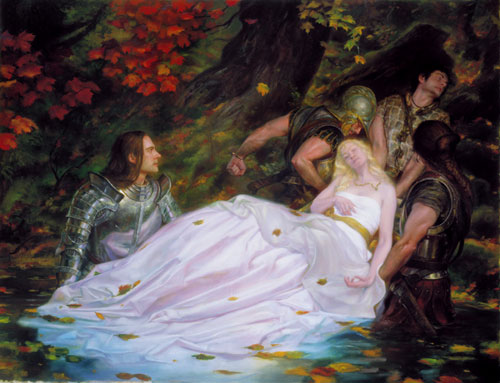
http://mseffie.com/assignments/shalott/art/elegy.jpg
"She has a lovely face."

Well that was philosophical. I feel like Cicero. Have a fantastic weekend, everyone!


Saturday, February 8, 2014

Kennedy's Camelot


A Modern Camelot: The Kennedy Brothers

When I hear or think about the word "Camelot" I immediately think "Kennedy."  The Kennedy family has often been associated with the  legendary Camelot.  The men were attractive, young, influential, and charismatic. The women and children were beautiful.   President Kennedy and the first family were certainly photogenic. Did the Kennedy's hold the keys to the kingdom for a while--a modern Camelot?  Some people would say "yes."  Others might call the Kennedy Camelot a piece of Madison Avenue myth making.  Christopher Snyder's statement "Like all myths it contains truths, though not usually literal ones" (The World of King Arthur) might be applied to Kennedy's Camelot, the  presidency and the political activism of his brothers.   


"Creating Camelot," is an exhibit at the Newseum, on display until March 16, 2014.  The show features the photography of Jacques Lowe, personal photographer of President John F. Kennedy.  How are legends made?  Photographs are one way to create visual narratives and lasting impressions that shape history.  

Jacques Lowe's photographs helped construct a romanticized portrait of a president and his family.  In contemporary society there are many ways to create, reproduce, and spread stories, images, and  impressions. Archiving information, documenting history or creating myths, has never been easier with modern technology.   When people hear the phrase "going viral," they do not associate it with influenza epidemics.  In King Arthur's day, it was the bard or storyteller that carried news or fashioned a captivating tale.  Stories traveled by foot, horse, and ships--a slower pace then today's news. 

Where is the truth in a story if it is not literal?  Whether it is a 20th century president or a 6th century king, the pictures, emotions, and embellishments of the storyteller might actually be closer to the truth then a dry listing of facts. Here is an example of literal truth and truth.  Looking at the itemized, paper receipt of groceries bought with food stamps is a true record of poverty.  However, the grocery receipt is not as powerful a picture as my friend Gary's story.  He once told me he didn't like coffee because "As a kid I was left alone for the weekend.  The only thing in the house to eat was a jar of instant coffee crystals." Gary's family had bouts of underemployment.  It is true that instant coffee will not feed a child's hungry belly.  Both the receipt and Gary's instant coffee indicate true things; but only one truth is an indelible story from over thirty years ago. 

Maybe, as suggested by Christopher Snyder,  the truth  of the Arthur's Camelot is about what makes a virtuous king,  or the beginnings of a national identity, or the romantic vision of an ideal place and time.  Perhaps  the same could be said for Kennedy's Camelot captured in the photographs by Jacques Lowe on display at the Newseum.