Showing posts with label Courtney Lapsley. Show all posts

Saturday, May 3, 2014

Woe be the Day Where it All Ends

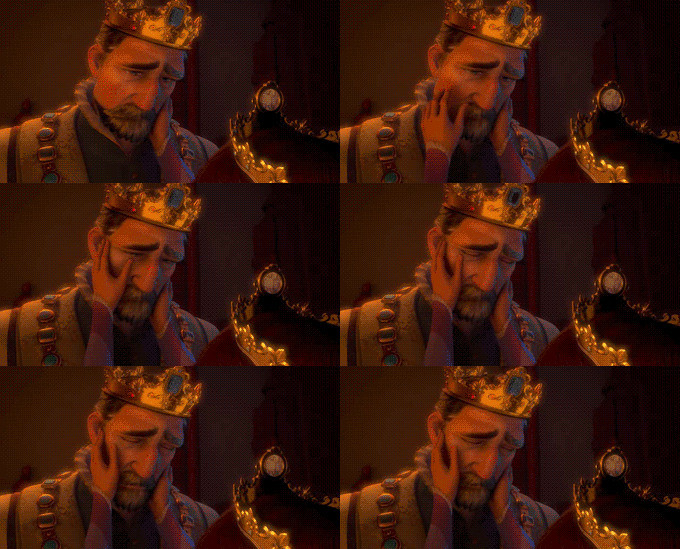
                                                      The King In Disney's Tangled

Every great reign has got to come to an end, and it seems that the end of the King Arthur class will be included in this great ending. I will miss this class and everything it was able to teach me about the man and the legend. It explored the depths of the beloved king who I grew up with in writing and through the screen of the television. He was the king that I thought all kings were supposed to be like, and as a small girl of eight watching Quest for Camelot, I thought that our country should also have a king like Arthur. Even when my mom explained that not all kings were good I did not believe her. Even as a kid, I still swore loyalty to King Arthur and even though he was not tangible, his beliefs and charisma had captured the heart of that little girl and continues to hold it to this day. So I was overjoyed to find and take this class on my beloved Medieval King, read about something that was consistently present through my life, and analyze texts for their relevance and believability.  
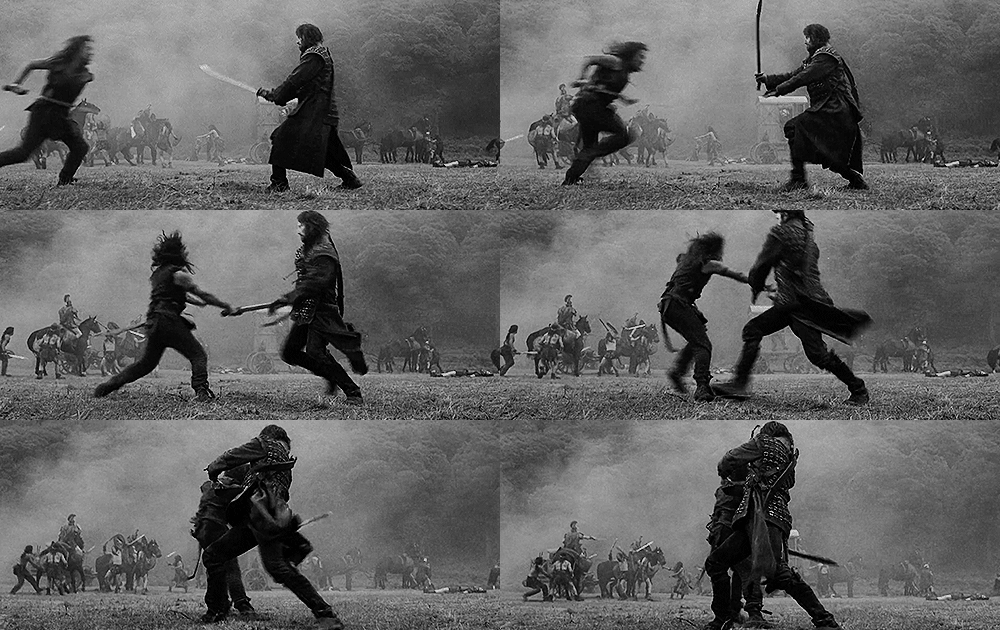
               
               
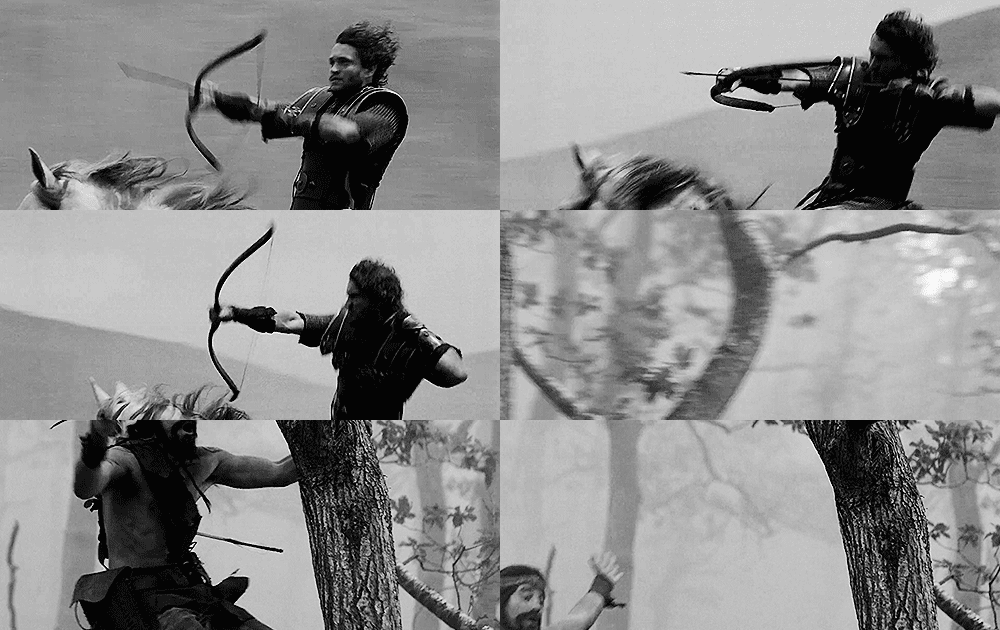
                        Tristan (top) and Galahad (bottom) in the King Arthur movie 2004

When I first began this class I thought that I really would not learn much more about a topic that I was well versed in. I believed that King Arthur was just one man with many knights, an evil son, a weird sister, a magical wizard, a loose wife, and a great kingdom. However, there are many faces and portrayals to the King Arthur legend and the king himself. Overall,  I enjoyed learning about his fellow knights the most. This is why the reading of Le Morte D'Arthur by Sir Thomas Malory was my favorite reading of the class this semester. This is depicted above with Galahad and Tristan (or Tristram) as they fight their way to victory. I enjoyed hearing about the men who protect the king and are usually left in the shadow of Arthur or the other two well known knights: Lancelot and Gawain. In Malory's book he explores two knights that I had barely heard of before and it refreshing because with the new knights that I was learning about, there was a new adventure and story. There was a grail of greatness and a religious aspect to King Arthur that had nothing to do with war and defending God through combat. Also, Galahad was Lancelot's son, which frankly, I never read about the knights of the Round Table having children. There is a story of a boy of relatively noble birth fighting for greatness and honor without revealing his name because he had killed the son of the liege who he stayed with to heal. So Sir Tristram and his secretive name Tramtrist was a humourous and exciting twist on the King Arthur legend. It delves into the mind of a man and his journey to become a knight, much like the story of the Grail and how Galahad had refrained from fighting and sin to achieve holy goodness. They were exciting stories because they were new, and different, and although they were dry at times, I liked their message and story!
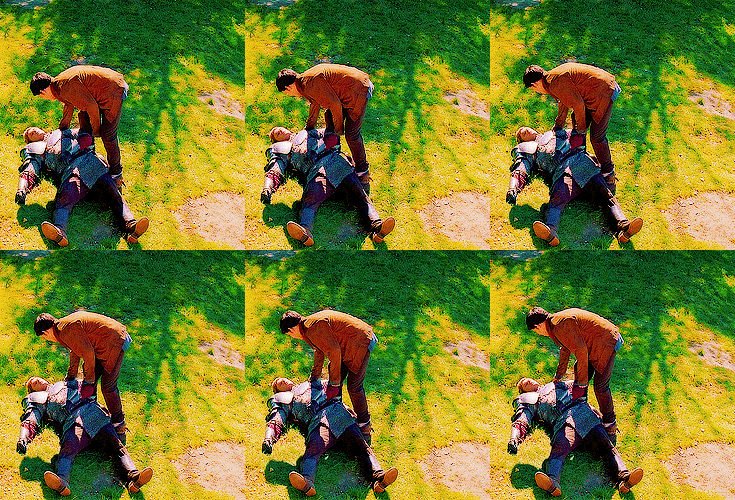
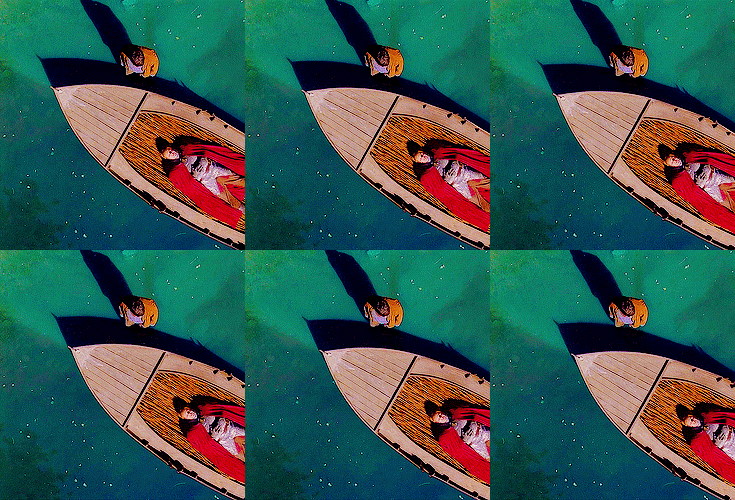
             
                                           Arthur's death  in the TV show Merlin

Although this class has explored the many faces of Arthur, including the child, teenager, adult, and old man who explored different gateways and personality traits like being righteous, honorable, lazy, ambitious, dependent, and wise I have realized that in the end, Arthur always dies. That he is human and not a machine that keeps going into time and space as an immortal shell of a man. He dies from flesh wounds just as his men do, and that makes him real, a leader that risks his life, and can die by the hand of a sword. Just like he is depicted in the Merlin series above; Arthur dies and his good friend Merlin watches him drift off as preparations for his Viking funeral. However, besides getting to read about Arthur's knights and their stories on becoming a chivalrous representation of the Round Table (and sometimes not) I was really happy to see this vulnerable side to Arthur. Although he may have Excalibur, steel armour, and a barrier of knights defending him he still fell because he was still a man who bled. The difference between Arthur and other kings also became apparent through this class. Arthur wanted a kingdom full of people; not an empty kingdom full of wives and children waiting for fathers, brothers, and sons to come back from a battlefield.   

Thursday, April 24, 2014

If You Vote For Me All Of Your Wildest Dreams Will Come True


SO in the spirit of Knight Life, I thought it was only appropriate for a Napoleon Dynamite reference and supporting picture because it was a very....interesting movie that I used to quote in middle school. Also I feel that the idea of Pedro is very similar to King Arthur because his campaign is a little strange, as is his speech. He begins with "Hello, I don't have much to say. But I think it would be a good idea to bring some holy Sancho's to the high school..." which is definitely bizarre and attention grabbing. But whoa! This takes place in a high school which is the same as Avalon High! Look at me making connections, no it's okay, I know it's not funny. But yeah, Pedro, King Arthur, and I never thought I would be connecting the two, but I mean I think its okay since Knight Life was supposed to be funny or the author probably wouldn't have had weird demons, an invisible sword, a really dumb Percival, a whimpering Gwen, and a 9-year-old Merlin with as people have been mentioning...a lot of sass.


Also this book reminded me of a movie that I watched a long time ago and only remember the basic premise but it was called "A Kid in King Arthur's Court." Mostly because of the weird time gap in Knight Life and this movie; however, the big difference is that the modern kid is thrust into the world of Camelot instead of King Arthur being thrust into the modern world. It is a bit of a swap. Anyway I just get excited when I remember things and can relate them to the times when I was growing up. I haven't watched this movie in a LONG time and then after Knight Life I was like "Oh man this movie." However, it might be because I am also reading "A Connecticut Yankee in King Arthur's Court" but it still came through! I was just wondering how it would be if the roles were swapped, and if it was just a regular person from today that was tripping into a time portal to Camelot. I mean I would probably accidentally look at someone weird in the first two minutes and get chopped up ( they probably made this a kids movie to avoid the fact of imminent death) but hey there is always that small percentage of survival in this imaginary scenario that will never happen. But just imagine a kid from the modern world trying to become a knight! It is just as hilarious and ridiculous!

Wednesday, April 2, 2014

Is That You, My Dear Sir?

                                             Lancelot in the movie Lancelot du Lac (1974)

I have always been intrigued by Lancelot in the legends of King Arthur. In all the compilations of movies that I have watched it was almost like all of these directors got together and had him drawn out and represented in the same way. He was the best sword fighter and lancer, the noblest of knights, and always had that darned beautiful flowing hair that will always rival all of his brother knights. Since I am very much obsessed with knights and their differences I sort of hone in on abnormalities or lack-thereof.

Although I first began to question everything I have ever known about Lancelot in Malory's Le Morte d'Arthur. In the Tale of the Sangreal, Lancelot's image changes drastically because through a series of steps it is shown that he is not  virtuous and sin-free beneath that hunk of shining armor.The people of King Arthur’s court have always been idolizing him; “Oh hey, Lancelot is beautiful, strong, and virtuous in every single way” that Lancelot’s core is never really talked about. I cannot really blame him, if people praised me every day I would probably get a little hot-headed too. The point is that in this tale Lancelot is not a golden pillar of greatness and being able to see his weaknesses helped to change my perspective on the knights I have filed away in my subconscious.
                                              Lancelot in the movie King Arthur (2004)

More recently discussed in class is the Sir Lancelot in regards to the Tennyson poem "The Lady of Shalott" in which he is once again that beautiful knight in shining armor that captures the heart of the lady toiling away in the tower. I know that technically Lancelot has nothing to do with the lady's foreboding death because he cannot help it if women fall for his pretty face and beautiful singing voice; however, it does put Lancelot in a bad light. At the end of the poem, he only glances at the poor lady's corpse which is "pretty" and she is put aside. Yet, he did not know the lady. I suppose Lancelot becomes a regular guy, and that in itself is upsetting because (in my mind) he was previously in a high place that was nearly otherworldly in virtue and bravery.


1 of  5

Monday, February 3, 2014

Oh! Such Magnificence and Fame in Your Round Shape!

The title does, in fact, refer to the Round Table; the one that brought all of King Arthur's knights together for some nice, manly bonding in politics and war ( Ah those bloody Romans).  And perhaps just to chat...no probably not.
They just look so symmetrical, it's amazing! I really like this depiction of the round table from First Knight

But you are probably thinking "Duh, the Round Table is Arthur 101" and you would be right, since it is brought up so often in Arthurian legends that it goes hand in hand with Camelot! However, to me the table also brings together the knights whom I have grown up reading about since I first began my journey with this king of legend.

The  book above was written by Gerald Morris, and is included in my influence map! I read the book in sixth grade, and it actually focuses more on Gawain, and his page Terence, then on King Arthur. This book also made me more fascinated with the knights of the round table in general ( it was also humorous as the front cover demonstrates, I mean I usually don't ride a horse in that manner). So instead of focusing on the king himself the books succeeded in glorifying Arthur through his knights and the people, much like legends show.

"...these three rings represent
the unity of our kingdom.
As a knight, I took an oath...to protect Camelot, King Arthur
...and Excalibur."
With the round table, and the knights who sit there, there comes to mind the great sword of King Arthur: Excalibur. I grew up with the beautiful movie Quest for Camelot ( thus the picture) and so I have always viewed the sword as a mighty magical gift that brings the kingdom together. Yet, in the reading Geoffrey refers to the sword as Caliburn. I was puzzled at that moment but after looking into the name I discovered it was the same sword but just different context. Meaning: it is the difference between Welsh legend (Caledfwich) and the later altered name in Continental Europe: Excalibur. Yes, it bothered me immensely why the sword had different names! Glory to the internet for leading me to salvation!