Showing posts with label Galahad. Show all posts

Saturday, May 3, 2014

Woe be the Day Where it All Ends

                                                      The King In Disney's Tangled

Every great reign has got to come to an end, and it seems that the end of the King Arthur class will be included in this great ending. I will miss this class and everything it was able to teach me about the man and the legend. It explored the depths of the beloved king who I grew up with in writing and through the screen of the television. He was the king that I thought all kings were supposed to be like, and as a small girl of eight watching Quest for Camelot, I thought that our country should also have a king like Arthur. Even when my mom explained that not all kings were good I did not believe her. Even as a kid, I still swore loyalty to King Arthur and even though he was not tangible, his beliefs and charisma had captured the heart of that little girl and continues to hold it to this day. So I was overjoyed to find and take this class on my beloved Medieval King, read about something that was consistently present through my life, and analyze texts for their relevance and believability.  
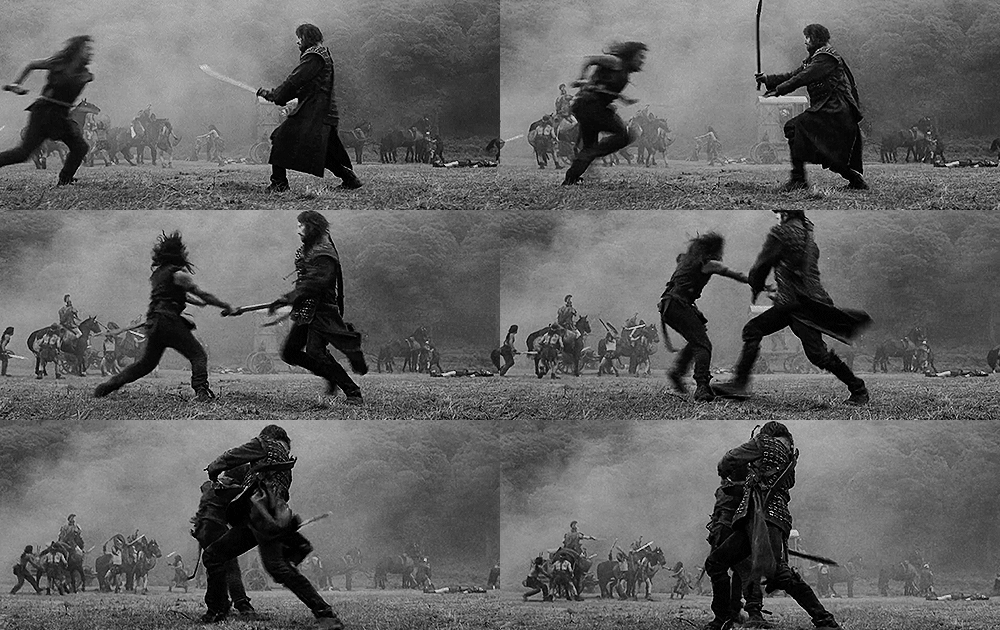
               
               
                        Tristan (top) and Galahad (bottom) in the King Arthur movie 2004

When I first began this class I thought that I really would not learn much more about a topic that I was well versed in. I believed that King Arthur was just one man with many knights, an evil son, a weird sister, a magical wizard, a loose wife, and a great kingdom. However, there are many faces and portrayals to the King Arthur legend and the king himself. Overall,  I enjoyed learning about his fellow knights the most. This is why the reading of Le Morte D'Arthur by Sir Thomas Malory was my favorite reading of the class this semester. This is depicted above with Galahad and Tristan (or Tristram) as they fight their way to victory. I enjoyed hearing about the men who protect the king and are usually left in the shadow of Arthur or the other two well known knights: Lancelot and Gawain. In Malory's book he explores two knights that I had barely heard of before and it refreshing because with the new knights that I was learning about, there was a new adventure and story. There was a grail of greatness and a religious aspect to King Arthur that had nothing to do with war and defending God through combat. Also, Galahad was Lancelot's son, which frankly, I never read about the knights of the Round Table having children. There is a story of a boy of relatively noble birth fighting for greatness and honor without revealing his name because he had killed the son of the liege who he stayed with to heal. So Sir Tristram and his secretive name Tramtrist was a humourous and exciting twist on the King Arthur legend. It delves into the mind of a man and his journey to become a knight, much like the story of the Grail and how Galahad had refrained from fighting and sin to achieve holy goodness. They were exciting stories because they were new, and different, and although they were dry at times, I liked their message and story!
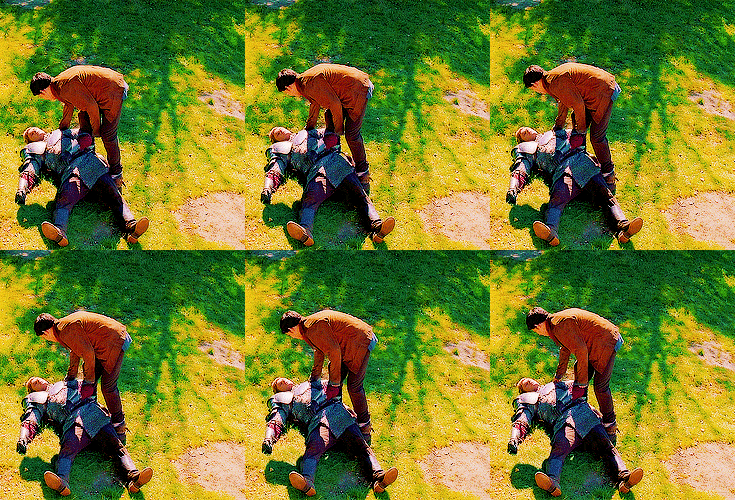

             
                                           Arthur's death  in the TV show Merlin

Although this class has explored the many faces of Arthur, including the child, teenager, adult, and old man who explored different gateways and personality traits like being righteous, honorable, lazy, ambitious, dependent, and wise I have realized that in the end, Arthur always dies. That he is human and not a machine that keeps going into time and space as an immortal shell of a man. He dies from flesh wounds just as his men do, and that makes him real, a leader that risks his life, and can die by the hand of a sword. Just like he is depicted in the Merlin series above; Arthur dies and his good friend Merlin watches him drift off as preparations for his Viking funeral. However, besides getting to read about Arthur's knights and their stories on becoming a chivalrous representation of the Round Table (and sometimes not) I was really happy to see this vulnerable side to Arthur. Although he may have Excalibur, steel armour, and a barrier of knights defending him he still fell because he was still a man who bled. The difference between Arthur and other kings also became apparent through this class. Arthur wanted a kingdom full of people; not an empty kingdom full of wives and children waiting for fathers, brothers, and sons to come back from a battlefield.   

Tuesday, March 25, 2014

All Play and No Praying Makes Lancelot a Bad Dad


Hello! First post after spring break, so we will see how this goes! And as long as we are talking about spring break, let's talk about what spring break implies for people in their late teens and twenties...
Let's face it, this was all of us during our last class before spring break.
 

...or better yet, let's not. While many of us don't think of partying as an example that can be used in school (I'm taking a risk in doing so), it can be used in this King Arthur course. In fact, we discussed it in class. It is called a "carnivalesque" atmosphere: where societal rules don't apply and everyone can be free for a while. While we experience a carnivalesque atmosphere when we are in the moment (spring break being an example), we must later face the consequences of our actions. (Growing up really stinks sometimes, huh?) However, for the people in Arthur's court, this is not usually so. This past reading has been surreal because it is extremely different: there are dire consequences and people do not embrace a sinner (like those who wore the green sash in Sir Gawain and the Green Knight.) 
"Gwen babe, they found us out. So...I need some space."
 

Lancelot, who has been seen as one of Arthur's finest knights, has been having an affair with Guinevere for fourteen years now. He was praised in The Knight of the Cart, and it seemed that his sins (however romantic) were excused because of his great abilities. However, in the Quest for the Holy Grail, he is denied the Grail because he is not worthy. He has sinned in his affair with Guinevere, as well as in seeking for wordily glory and failing to thank God for his abilities. Who is worthy of the Grail, however? Galahad, Lancelot's son, and the product of a union he thought was between himself and Guinevere (this would have been adultery...one of the many times he had committed this). 
Sorry Lancelot, but you'll never be this guy to Galahad.
...Or even this guy.
 

This is very different from the glorious Lancelot we see in The Knight of the Cart, who is admired by young boys. This is a man who is unworthy of the Grail because of his sins, and is surpassed by his son, whose virtuous and good, and is nothing like him. There is something very sad in this...almost a foreshadowing of the end of Lancelot and the rest of Arthur's knights, and the age of worthier knights. Whether this happens, I do not know, but this reading is ominous. It implies a darker future of something yet to come. 

Oh and on another note...the lion in the story reminds me of this guy:
ASLAN!!!
 

I wonder if C.S. Lewis knew? Despite popular belief, his stories were based off of more than just Christianity. He was educated in mythology...I wonder if he was into Arthurian legend! ​

Monday, March 24, 2014

What Knights Carry: Symbols, Talisman, and Tattoos

Gawain's Shield- front 

Somewhere in a students’ academic career, like Dr. Reichard’s Phil 200 ”Courage and Violence,” he or she might encounter Tim O’Brien’s book The Things They Carried.  I have frequently been reminded of essays of O’Brien’s essays and stories as I read about tales of valor and of violence in Arthurian legend.  Soldiers, ancient or modern, bear particular truths greater than their actual stories. Humans often carry “good-luck” artifacts like: religious symbols and articles or relics, the cliché rabbit’s foot, a treasured love letter, a beloved’s trinket or item of clothing.  Sir Gawain gives us several symbols.  


The shield Gawain carries into battle has a pentangle on the outward facing side and the image of the Virgin Mary on the interior facing side.  While fighting, Gawain could draw strength and courage from the Blessed Virgin’s image.  The pentangle is a symbol with pagan and Christian meanings.  It is often associated with the five joys of Mary, the five knightly virtues, and the five wounds of Christ.  For protection, Gawain wears the sash into battle with the Green Knight.  Later the fellow “Knights of the Round Table” adopt the green sash too.  Looking at the box of Thin Mint Girl Scout Cookies in my cupboard, I am reminded of a gang of young girls that proudly wear a green sash. According to one of my classmates girls “can be knights too.”
"Thin Mint"--yumm!


Sir Galahad


Malory’s Galahad carries a shield with significant symbolism too.  Malory tells us that Galahad’s shield is white with a red cross. The shield descends from his ancestor Joseph of Arimathea. Legend tells us that Joseph of Arimathea was the soldier that removed Jesus from the cross. It is blood pouring from Joseph’s nose that forms the red cross of Galahad’s shield (Le Morte d'Arthur).


What do people wear as they face modern challenges? What symbols do they weave into the quests and campaigns of their lives? Are we so different or more sophisticated than our forbearers?  Our lives are filled with symbols and images. Look at the ubiquitous tattoos!  Gawain’s religious symbolism pales by today’s religious tattoos.   Arthur wore an aegis of the Virgin Mary across his shoulders. What might Gawain’s or Arthur’s Mary look like today?  Many tattoo artists have inked the Virgin Mary.  


Tattoos and body scarification have been around for thousands of years.  Several times, on assorted tattoo websites, I have read that knights during the Crusades would have the Jerusalem cross/Crusader’s cross tattooed on a hand or forearm to identify them for Christian burial. I’m not sure if it is factual but branding and tattoos have been used for ages for identification purposes--think animal identification, American slavery, and Nazi concentration camps. Mrs. Malcome, my fourth grade elementary school teacher, had a concentration camp tattoo.  Full of quiet strength and courage, Mrs. Malcome was my childhood hero.  

"Pastrix" Rev. Nadia Boltz-Weber
Pastor of ELCA mission church
House of All Sinners and Saints


From gang members to Protestant ministers, tattoos are everywhere.  Rev. Nadia Boltz-Weber is one of those tattooed pastors.  What symbols or tattoos do you carry?