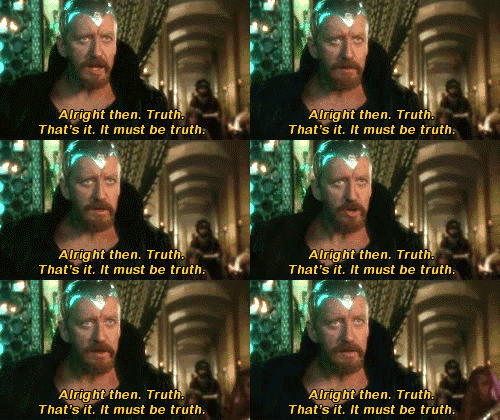
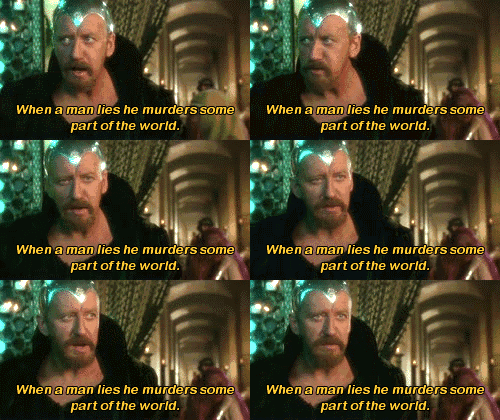
Saturday, February 15, 2014

50 Shades of Obsessed

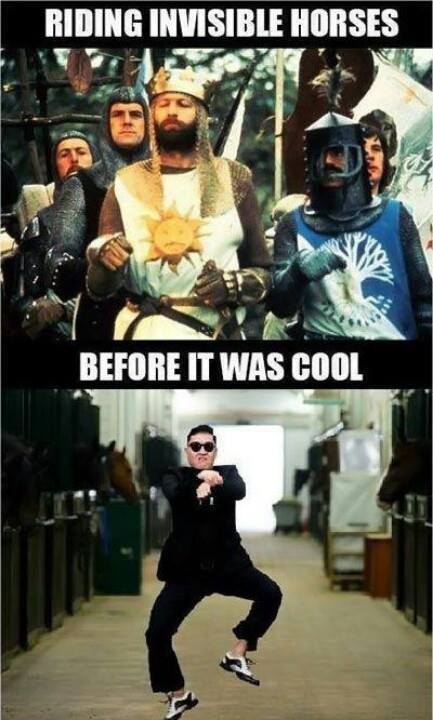
     Okay, the first thing I would like to get out of the way is that the knight in the cart had poor decision making skills when it came to transportation. He clearly didn't watch Monty Python because it's always been cool to ride pretend horses (apparently). What's with putting multiple real horses and his dignity in danger when he could ride up in style like these guys?

     On a more serious but nowhere near serious note, this knight is 50 shades of obsessed. Who cherishes a lady's hair like that? If there were doubts of him being a stalker before this moment, they're gone now. If you witnessed someone doing his with hair they found in a comb present day, you would run, fast, and probably until you found a lock to hide behind. I can't call the knight crazy because he is still somewhat in his right mind at other moments. He's not letting this obsession control his every move completely, but wow. Just wow.
     Thinking about the women who enjoyed reading this story, it makes sense because it probably does help them satisfy their yearning for the love their husbands can never give them. This story lets the women live vicariously through the queen's character. It helps them escape their reality, which is the same reason many people read books today. The fantasy they escape to is questionable, but I guess it's relative to some extent. 
     To close, I'll just leave this here (thank God for tumblr).


Courtly Bullshit...*coughs* Ahem, Courtly Love.

I have to say, the reading for the past week...so many feels.

The first this that really sunk into my mind was the riding in the Dwarf cart shame.  Lancelot was (like what Dr.MB said) "Scarlet Lettered" and somehow strangers and everyone in different areas knew about.  I mean, how is there so much shame bestowed upon Lancelot for that tiny, and in my opinion, harmless action?

I think there was this overly exaggerated idea of being honorable-in the terms of being a knight in courtly love.  Because Lancelot wasn't proudly striding his way a long distance to the girl and was riding in a Dwarf cart, people looked at him with disgust.  (wow, I said that out loud and laughed for 3 minutes).  That's kind of ridiculous.  He was already on his way...the fact that his every action has to be in accordance to this unattainable code of ethics, just tells me how ludicrous the ideals of honor, valor and being worthy of courtly love was.

I think courtly love was created out of the delusions thought up by an emotional starved and handicapped individual.  The Rules of Courtly love that we talked about during class...courtly love is an emotional paradox.  It's no wonder people in the times of King Arthur couldn't have a resolution in their courtly love that actually satisfies- meaning that the end result is either incomplete or that the love cannot be fulfilled.  You are left feeling sad..bad way to end a romantic story...or is it?

Friday, February 14, 2014

The Knight of the Cart

I don't know about anyone else, but this reading was fantastic. There were numerous parts in the story that brought to life what I had imagined this time period being like. For instance, the part in the story where Lancelot jousted with his opponent. To me, jousting comes to mind every time I here the word "knight". Also the loyalty that is shown throughout the story is something that comes to mind when I think of knights. The story also captured my interest because of the way it was written. The way the that it was written using both old and modern day language helped to better understand it whereas other texts with related material might be written in a way that is hard to read and understand because of the style of language it is written in. The parts that I find the most interesting is the part where the women is supposedly being raped. At first when Lancelot arrives at the woman's home she tells him that no one else besides she lives there. Then a few paragraphs later there are men all around her. But that is still not the part that I find interesting. Lancelot begins to fight the men and is cut by an ax. He then ends up killing one of the men. Again, this is not the part that I find the most interesting. the part that i find interesting is that after Lancelot is injured and after he kills a guy, the women dismisses the men who were attacking her and tells the knight that he has nothing to worry about. I find this interesting because since she dismisses the men, that means that they were under her command. Not only did Lancelot become injured in the "fight", but one of the men died. I interpreted this as an order that was given knowing that someone might be injured or even killed. That is amazing that someone could be so loyal to someone. The other part I enjoyed was the sword bridge section. In the beginning when they said that the bridge was called sword bridge, I had no idea that it was an actual sword. I loved the part where Lancelot  took his armor from his hands and feet off. It was an actual sword and he takes of his armor. Granted, it was in order to get a better grip, but still that is insane. 
 

The Unreliable Narrator

http://i.dailymail.co.uk/i/pix/2011/08/09/
article-2024083-0D5D754800000578-860_468x305.jpg
The reading from Geoffrey of Monmouth, The History of The Kings of Britain (Romance of Arthur), describes King Arthur with qualities that are commonly associated with him. He is labeled as a person who has "valor, natural goodness, grace, generosity, and merciful"(610). He is strategic war, and he listens to the counsel of others (65). That is the expectation of King Arthur, and that is the character that Geoffrey of Monmouth gives to audiences. Through his descriptions and his "historical accounts", Geoffrey of Monmouth produces a King that people want to have, and who they will admire and follow.

http://tubtub.deviantart.com/art/
Geoffery-of-Monmouth-41451678
If looking at Geoffrey of Monmouth as a storyteller/historian, I do not think he can be considered trustworthy. In Senior Seminar, we are focusing on the "unreliable narrator", and that is what I felt about him. Clearly, there were parts in his accounts that were fiction or legend, but the parts that could be seen as history seemed to be weighed down with his own biases. Why would Geoffrey of Monmouth be biased? The main reason would be because he is from Britain. The accomplishments Arthur achieves, benefits his people and decedents, and Geoffrey of Monmouth falls under this category. However, the people who Arthur conquers or battles might not be as willing to call a just and merciful king. 

http://www.freewebs.com/300spartanhq/helmet%20arthur.bmp
When taking away all the compliments and praises that Geoffrey of Monmouth gives to King Arthur, it is easy to see how in situations the King is not compassionate and kind, but rather tyrannical. In one description, after Arthur had conquered a land, and the people were trying to repair their homes, he was reported to feel "exalted that he was a source of dread to everyone, and he longed to win all of Europe for himself" (Romance of Arthur, 69). King Arthur is ruling in a dictatorship, leaving me to ask, what happened to the "natural goodness" that Geoffrey of Monmouth describes (Romance of Arthur, 65)?

After seeing this side of King Arthur, I question the reliability of Geoffrey of Monmouth's word. He might not be trying to mislead people, but his perspective of Arthur is weighted, based on the group that Geoffrey of Monmouth identifies with in this case Britain. His perspective is understandable, but it buries some of the ideas that King Arthur was not the perfect ideal king that he was glorified to be.

Sunday, February 9, 2014

First thoughts of King Arthur

There are several reasons I decided to take this class; I am ignorant of King Arthur and wanted to learn more about him, I thought the class would be very interesting, and I thought it would be a reasonably easy class. When I think of King Arthur I think of two things. The first would be the movie, The Black Cauldron. In my head, I picture King Arthur as showed in the picture below: 
The second would be of Camelot in the Warner Brother's version called Quest for Camelot. However, when doing the assigned reading, Arthur in Geoffrey of Monmouth, I got a totally different picture of Arthur. He controlled a lot of Europe and was described as being a giving ruler. I thought it was very deceitful of his nephew, Modred, to take over his kingdom. After reading all of the wars he had been in, my first reaction was that King Arthur's rule was finally over. He had more than enough time as a ruler and he needed a successor, although it was not right the way Modred went about it. After reading this story, I pictured King Arthur somewhat looking like in the picture to the right.

As stated earlier, I am very ignorant of King Arthur and his legends. I took a literature class last semester and we had to read Sir Gawain and the Green Knight by JRR Tolkien. I really enjoyed reading that story, which is another reason that influenced me to take this class. I look forward to learning more about King Arthur because there are so many legends about him. Plus, he seems so interesting.

Saturday, February 8, 2014

Kennedy's Camelot


A Modern Camelot: The Kennedy Brothers

When I hear or think about the word "Camelot" I immediately think "Kennedy."  The Kennedy family has often been associated with the  legendary Camelot.  The men were attractive, young, influential, and charismatic. The women and children were beautiful.   President Kennedy and the first family were certainly photogenic. Did the Kennedy's hold the keys to the kingdom for a while--a modern Camelot?  Some people would say "yes."  Others might call the Kennedy Camelot a piece of Madison Avenue myth making.  Christopher Snyder's statement "Like all myths it contains truths, though not usually literal ones" (The World of King Arthur) might be applied to Kennedy's Camelot, the  presidency and the political activism of his brothers.   


"Creating Camelot," is an exhibit at the Newseum, on display until March 16, 2014.  The show features the photography of Jacques Lowe, personal photographer of President John F. Kennedy.  How are legends made?  Photographs are one way to create visual narratives and lasting impressions that shape history.  

Jacques Lowe's photographs helped construct a romanticized portrait of a president and his family.  In contemporary society there are many ways to create, reproduce, and spread stories, images, and  impressions. Archiving information, documenting history or creating myths, has never been easier with modern technology.   When people hear the phrase "going viral," they do not associate it with influenza epidemics.  In King Arthur's day, it was the bard or storyteller that carried news or fashioned a captivating tale.  Stories traveled by foot, horse, and ships--a slower pace then today's news. 

Where is the truth in a story if it is not literal?  Whether it is a 20th century president or a 6th century king, the pictures, emotions, and embellishments of the storyteller might actually be closer to the truth then a dry listing of facts. Here is an example of literal truth and truth.  Looking at the itemized, paper receipt of groceries bought with food stamps is a true record of poverty.  However, the grocery receipt is not as powerful a picture as my friend Gary's story.  He once told me he didn't like coffee because "As a kid I was left alone for the weekend.  The only thing in the house to eat was a jar of instant coffee crystals." Gary's family had bouts of underemployment.  It is true that instant coffee will not feed a child's hungry belly.  Both the receipt and Gary's instant coffee indicate true things; but only one truth is an indelible story from over thirty years ago. 

Maybe, as suggested by Christopher Snyder,  the truth  of the Arthur's Camelot is about what makes a virtuous king,  or the beginnings of a national identity, or the romantic vision of an ideal place and time.  Perhaps  the same could be said for Kennedy's Camelot captured in the photographs by Jacques Lowe on display at the Newseum.


Friday, February 7, 2014

The Attempt to Disillusion Me

http://images6.fanpop.com/image/photos/32900000
King-Arthur-arthur-and-gwen-32900096-500-661.jpg

What characteristics come to mind when thinking of King Arthur? Who is he as not just a King, but as a man? For me, I envision someone who is courageous and brave, which he demonstrates through the different battles he fights. He believes in fairness and equality, which is represented through the idea of the Round Table, where no one sits at the head of the table making all the Knights equal. He's a protector of his people, and as a result he has earned their respect, loyalty, and love.

Arthur is the ideal King. He is symbolic of what other Monarchs should strive to be like. He is a King who does not just cares for his people in words, but serves them in action. I think that has a lot to do with King Arthur's appeal. He seems to base his decisions on what he truly believes is in the best interest of his people and his kingdom before anything else. His actions and behaviors makes him the type leader people wish they have.

Our text, from last week, tried to disillusion me, and, thanks to Dr. Mitchell-Buck's underlining, I noticed it.  In our Who Was Arthur reading from Snyder, there was a very brief description of Arthur as a "tyrannical monarch" (15). One of the OED definitions of a tyrant is "a ruler who exercises his power in an oppressive, unjust, or cruel manner", so I never imagined King Arthur in this role.  The description in the reading actually shocked me because it was so far from the ideas of what I have had about Arthur as a King.

The Most Menacing Picture of King Arthur I could Find
http://images.rtsguru.com/articles/images/2000/1386/KA.jpg
Yes, I am aware that my ideas were naive. Most rulers will have someone, somewhere who has the perspective that they are an unfair, I just never pictured it with King Arthur. However, I guess on reflecting on it, Arthur, was a King and he was a ruler. Not everyone can be happy, and someone is going to be his enemy or someone in his kingdom is going to be suffering somehow like from hunger or poverty.

                                           My other favorite Monty Python Moment
                                        http://www.youtube.com/watch?v=-8bqQ-C1PSE

Maybe King Arthur was not the perfect King in all his stories that I have imagined, but the idea of being a tyrant is not comforting one. I like the idea of Arthur being a model of a good king. Even if he makes mistake, I like the fact that that he considers the people around him, and I do not picture a tyrant doing that. There are big differences in the images I have of King Arthur and images of tyrants. I want to keep some of those ideas I have of Arthur being good because there is a big difference from the Arthur above, with a storm around him and blood dripping off his sword, and this…
http://static.tumblr.com/cwwlyeu/8LJlufqo8/tumblr_ltfnntuxnt1qb5ym2o1_500.gif